Duke Cancer Institute Announces New Thyroid Cancer Center
Published
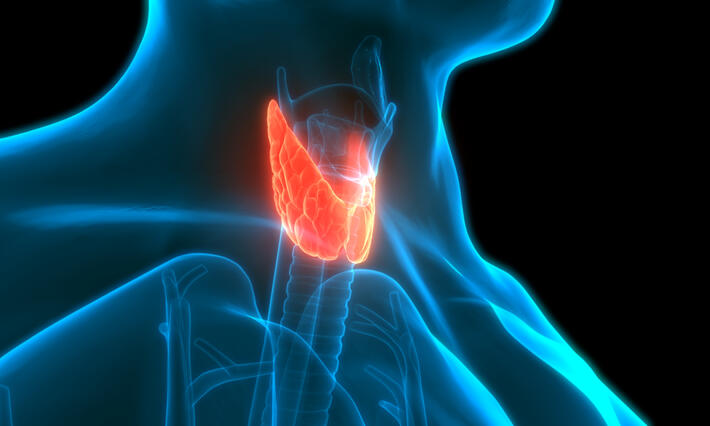
The Duke Cancer Institute has launched the Thyroid Cancer Center, a multidisciplinary hub dedicated to delivering the highest level of care for patients with thyroid disease. The center is led by endocrine surgeon Randall Scheri, MD; endocrine oncologist Todd Frieze, MD; head and neck surgeon Russel Kahmke, MD; and head and neck oncologist Jameel Muzaffar, MD.
This center brings together a team of experts in endocrinology, surgery, oncology, and other specialties who will utilize the latest medical advances and minimally invasive procedures to ensure optimal outcomes.
“DCI’s Thyroid Cancer Center is built on a foundation of collaboration,” Scheri said. “Our subspecialized teams span across Durham and Raleigh, offering system-wide access to a full spectrum of thyroid care.”
Within the center, centralized pathways connect patients to specialists in endocrinology, endocrine surgery, head and neck surgery, medical oncology, pathology, nuclear medicine, radiation oncology, genetics, interventional radiology and orthopedic surgery. The center will also offer advanced care in pediatric endocrinology and endocrine surgery with high-volume expertise in pediatric thyroid cancer.
Patients will have access to state-of-the-art cancer genetics testing and specialized thyroid cytopathologists and surgical pathologists. Additionally, the center will offer a weekly Endocrine Tumor Conference, bringing together a multidisciplinary team to ensure patients receive a personalized, evidence-based treatment plan.
“The Thyroid Cancer Center will strive to provide compassionate, expert care for patients every step of the way,” Frieze said.
Researchers at the Duke Cancer Institute (DCI) are working with collaborators at leading academic medical centers to explore a faster, less invasive way to detect and analyze head and neck cancers using light and artificial intelligence.In a recent study published in Biophotonics Discovery, a DCI team led by Tuan Vo-Dinh, PhD, partnered with Maie St John, MD, and clinical researchers at the University of California, Los Angeles (UCLA), to demonstrate how a light-based imaging technique combined with machine learning could help distinguish cancerous tissue with high accuracy. The work is now continuing at Johns Hopkins University.Today, diagnosing many cancers such as thyroid and head and neck cancers often relies on pathology or fine needle aspiration (FNA). In an FNA procedure, a thin needle is inserted into a tumor to collect cells, which are then analyzed by a pathologist.“While these approaches are widely used, they can be time-consuming and don’t always give clear or definitive results,” Vo-Dinh said. “In some cases, patients may have to wait weeks for answers, and the accuracy can vary depending on sampling and interpretation.”The collaborative teams used a technology known as Dynamic Optical Contrast Imaging (DOCI), a technique developed at UCLA, which uses laser light to excite tissue. When exposed to this light, different molecules in the tissue emit fluorescence—subtle signals that vary depending on whether tissue is cancerous or healthy. The result is a color-coded “map” of the tissue that reflects its biological properties.“Instead of looking at one spot on the tissue sample, this technique provides spatial information across the entire tissue region monitored,” Vo-Dinh explained. “You can actually see differences in how cancerous and non-cancerous areas respond to light.”These light-based signals are incredibly rich—but also complex. That’s where machine learning comes in. Vo-Dinh’s team applied machine learning algorithms to analyze the complex imaging data generated by DOCI. The researchers trained AI models to recognize subtle patterns in the imaging data and distinguish between different types of thyroid cancer, specifically papillary and follicular thyroid cancers, and to determine whether tissue was cancerous.The results were promising. The machine learning system showed strong agreement with pathological findings, accurately identifying cancerous regions within the tissue samples.“This is an exciting proof of principle demonstration that combining photonics with AI can work together and provide meaningful, reliable answers,” Vo-Dinh said. “The performance we’re seeing so far is very encouraging.”While the research is still in its early stages, the potential implications for patient care are significant.Because this approach directly analyzes the tissue and does not rely on waiting for lab-based assays, it could eventually support faster, point-of-care cancer assessment. Imagine a future where clinicians may be able to use similar tools directly on tissue, potentially even during surgery, to guide decisions in real time.“It could reduce the need for repeat biopsies and long waiting periods,” Vo-Dinh said. “And because the technique is non-invasive, it may also make screening easier and more accessible for patients.”The work underscores the critical importance of collaboration across institutions and disciplines, bringing together clinical expertise, advanced imaging, and data science.“This is a very synergistic partnership,” Vo-Dinh said. “Each group contributes something essential, from clinical insight to optical technology to computational analysis. That kind of complementarity is what drives innovation.”Next steps will focus on expanding and refining the technology, with the goal of enabling real-time, in situ cancer detection.“We’re excited to continue this collaboration and explore how far this approach can go,” Vo-Dinh said.
Radiotheranostics is a rapidly evolving field that combines targeted imaging and therapy using radiolabeled molecules. At Duke Cancer Institute, researchers are exploring new opportunities for this therapeutic approach in prostate and neuroendocrine cancer care through strategic clinical trials and interdisciplinary collaboration.Neuroendocrine Cancer: Building on a Legacy of InnovationMichael Morse, MD, medical oncologist with the DCI Gastrointestinal Cancer disease program, has had a longstanding collaboration with the Division of Nuclear Medicine and Radiotheranostics, particularly with nuclear medicine specialist Terence Wong, MD, PhD. Morse, Wong, and their teams have worked together integrating imaging and radiopharmaceutical treatment of neuroendocrine tumors (NETs).Duke was one of the early leaders in this research through work with I-131 MIBG, a radiolabeled compound previously used for treating neuroendocrine tumors, pheochromocytomas, and paragangliomas.More recently, Duke participated in the NETTER-1 trial which led to the FDA approval of Lu177-dotatate (Lutathera®) for gastroenteropancreatic NETs. The institution played a key role in subsequent compassionate use programs and has since become one of the leading centers in the Southeast for Lutathera® administration.More recently, Duke has been a top U.S. recruiter for the COMPOSE trial, a study comparing ITM-11, a novel lutetium-based therapy, to standard for patients with intermediate and high-grade neuroendocrine tumors.Morse also highlighted Duke’s opening of the BELU-RE trial, a national study evaluating Lutathera® in patients with pulmonary NETs, a group currently excluded from the FDA-approved indication of this drug. He said the growing interest in radioligands based on alpha emitters like Actinium-225 and Lead-212 offers higher energy and more potent DNA damage than traditional beta emitters.
Researchers at the Duke Cancer Institute (DCI) are working with collaborators at leading academic medical centers to explore a faster, less invasive way to detect and analyze head and neck cancers using light and artificial intelligence.In a recent study published in Biophotonics Discovery, a DCI team led by Tuan Vo-Dinh, PhD, partnered with Maie St John, MD, and clinical researchers at the University of California, Los Angeles (UCLA), to demonstrate how a light-based imaging technique combined with machine learning could help distinguish cancerous tissue with high accuracy. The work is now continuing at Johns Hopkins University.Today, diagnosing many cancers such as thyroid and head and neck cancers often relies on pathology or fine needle aspiration (FNA). In an FNA procedure, a thin needle is inserted into a tumor to collect cells, which are then analyzed by a pathologist.“While these approaches are widely used, they can be time-consuming and don’t always give clear or definitive results,” Vo-Dinh said. “In some cases, patients may have to wait weeks for answers, and the accuracy can vary depending on sampling and interpretation.”The collaborative teams used a technology known as Dynamic Optical Contrast Imaging (DOCI), a technique developed at UCLA, which uses laser light to excite tissue. When exposed to this light, different molecules in the tissue emit fluorescence—subtle signals that vary depending on whether tissue is cancerous or healthy. The result is a color-coded “map” of the tissue that reflects its biological properties.“Instead of looking at one spot on the tissue sample, this technique provides spatial information across the entire tissue region monitored,” Vo-Dinh explained. “You can actually see differences in how cancerous and non-cancerous areas respond to light.”These light-based signals are incredibly rich—but also complex. That’s where machine learning comes in. Vo-Dinh’s team applied machine learning algorithms to analyze the complex imaging data generated by DOCI. The researchers trained AI models to recognize subtle patterns in the imaging data and distinguish between different types of thyroid cancer, specifically papillary and follicular thyroid cancers, and to determine whether tissue was cancerous.The results were promising. The machine learning system showed strong agreement with pathological findings, accurately identifying cancerous regions within the tissue samples.“This is an exciting proof of principle demonstration that combining photonics with AI can work together and provide meaningful, reliable answers,” Vo-Dinh said. “The performance we’re seeing so far is very encouraging.”While the research is still in its early stages, the potential implications for patient care are significant.Because this approach directly analyzes the tissue and does not rely on waiting for lab-based assays, it could eventually support faster, point-of-care cancer assessment. Imagine a future where clinicians may be able to use similar tools directly on tissue, potentially even during surgery, to guide decisions in real time.“It could reduce the need for repeat biopsies and long waiting periods,” Vo-Dinh said. “And because the technique is non-invasive, it may also make screening easier and more accessible for patients.”The work underscores the critical importance of collaboration across institutions and disciplines, bringing together clinical expertise, advanced imaging, and data science.“This is a very synergistic partnership,” Vo-Dinh said. “Each group contributes something essential, from clinical insight to optical technology to computational analysis. That kind of complementarity is what drives innovation.”Next steps will focus on expanding and refining the technology, with the goal of enabling real-time, in situ cancer detection.“We’re excited to continue this collaboration and explore how far this approach can go,” Vo-Dinh said.
Radiotheranostics is a rapidly evolving field that combines targeted imaging and therapy using radiolabeled molecules. At Duke Cancer Institute, researchers are exploring new opportunities for this therapeutic approach in prostate and neuroendocrine cancer care through strategic clinical trials and interdisciplinary collaboration.Neuroendocrine Cancer: Building on a Legacy of InnovationMichael Morse, MD, medical oncologist with the DCI Gastrointestinal Cancer disease program, has had a longstanding collaboration with the Division of Nuclear Medicine and Radiotheranostics, particularly with nuclear medicine specialist Terence Wong, MD, PhD. Morse, Wong, and their teams have worked together integrating imaging and radiopharmaceutical treatment of neuroendocrine tumors (NETs).Duke was one of the early leaders in this research through work with I-131 MIBG, a radiolabeled compound previously used for treating neuroendocrine tumors, pheochromocytomas, and paragangliomas.More recently, Duke participated in the NETTER-1 trial which led to the FDA approval of Lu177-dotatate (Lutathera®) for gastroenteropancreatic NETs. The institution played a key role in subsequent compassionate use programs and has since become one of the leading centers in the Southeast for Lutathera® administration.More recently, Duke has been a top U.S. recruiter for the COMPOSE trial, a study comparing ITM-11, a novel lutetium-based therapy, to standard for patients with intermediate and high-grade neuroendocrine tumors.Morse also highlighted Duke’s opening of the BELU-RE trial, a national study evaluating Lutathera® in patients with pulmonary NETs, a group currently excluded from the FDA-approved indication of this drug. He said the growing interest in radioligands based on alpha emitters like Actinium-225 and Lead-212 offers higher energy and more potent DNA damage than traditional beta emitters.