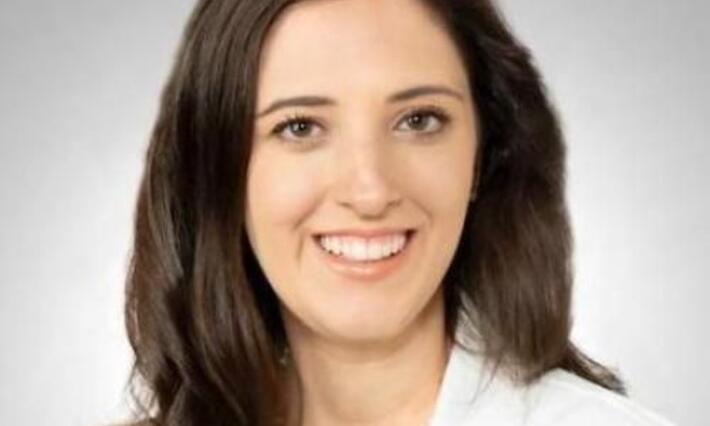
Talia Aron at home with her husband, Chad, and daughters Lily and Abigail. (Photo by Eamon Queeney.)
New Hope
Published
Talia Aron at home with her husband, Chad, and daughters Lily and Abigail. (Photo by Eamon Queeney.)
TALIA ARON, MD, WASN’T ALARMED AT FIRST WHEN SHE STARTED TO FEEL SOME NASTY LOWER BACK PAIN. Last September, the medical director at a telehealth company had been traveling to professional conferences for days, sitting on airplanes and in hard-backed chairs.
But instead of getting better when she returned home to Greensboro, North Carolina, the pain got worse. “Looking back at a picture of me [at a conference] in Nashville, I was kind of a grey color,” Aron said.
By the time she saw her OB-GYN, the pain was so bad that her physician sent her straight to the emergency department in Greensboro.
Doctors at first thought that Aron had a kidney stone or infection. Then she was diagnosed with kidney cancer.
When she sought a second opinion at Duke, she received what would turn out to be the correct diagnosis: a urothelial cancer that had already clawed its way into her kidney. Urothelial cancers include all cancers that grow out of cells that line the bladder and the ureters (tubes that drain urine from the kidneys to the bladder).
Historically, people with advanced urothelial cancer live, on average, for 16 months, with only 10% surviving five years or more on standard-of-care therapy.
But doctors at Duke had a new treatment in mind for Aron that offered her much better odds. The only problem was, the combination therapy, developed by a medical oncologist at Duke Cancer Institute, was only approved for a select population of patients at that time. She would need help from friends and physicians at Duke and beyond to get the best treatment for her.
Getting the Right Diagnosis
Talia Aron at home in Greensboro, North Carolina. (Photo by Eamon Queeney)
After Aron returned home, imaging showed a mass on her kidney, and it was growing rapidly. A urologist in Greensboro scheduled her for surgery to remove the kidney.
But just a few days before the scheduled surgery, James Wantuck, MD, one of her senior colleagues, encouraged her to seek a second opinion through 2nd MD, one of the health benefits offered by their employer, Accolade. That virtual consult — with David Braun, MD, PhD, a genitourinary medical oncologist at Yale School of Medicine — led her to Duke.
“Dr. Braun told me, ‘You are an hour away from Duke. You need to see the best,’” she said.
Braun reached out to Daniel George, MD, a genitourinary medical oncologist at Duke Cancer Institute and co-leader of the DCI Center for Prostate and Urologic Cancers. Braun asked that George be on the lookout for Aron. Meanwhile, Aron arranged a meeting with Deborah Kaye, MD, a Duke urologic oncology surgeon, to get a biopsy of her tumor.
Even before seeing the biopsy results, Kaye suspected that Aron’s tumor might not be kidney cancer.
Kaye asked Aron the location of her pain. “When I pointed to my side, Dr. Kaye said that I should not be having pain there if this were kidney cancer. Then Kaye looked very carefully at my previous images and said that she thought I might have urothelial cancer. And she was the first one to have said that,” said Aron.
While Aron was waiting in the clinic for her biopsy results, she started feeling worse. “I was getting rigors — shakes. I couldn’t get warm. I had a very high fever, which I now know is not uncommon with very aggressive cancers, but I didn’t know it then.”
The biopsy confirmed an upper-tract urothelial cancer that appeared like a kidney cancer because it had already spread there.
“Nailing down the specific type of tumor that someone has is critical, because the drugs we use to treat urothelial cancers are completely different from kidney cancer drugs,” said George. “And it’s something we do well at Duke, where we have experts from medical and surgical specialties who work closely with cancer-specific pathologists and radiologists.”
“I’m a little tearful when I talk about it. If it wasn’t for Duke and Dr. George being willing to take me on, I don’t know if I’d be here for my two daughters, who are 9 and 15.” — Talia Aron, MD
The Tough Road to a New Therapy
The therapy that Aron would ultimately receive is a combination of pembrolizumab, an immunotherapy agent, and enfortumab vedotin, an antibody drug conjugate. Duke medical oncologist Christopher Hoimes, DO, had been studying this combination since 2017.
Hoimes’ reasons for believing that these two agents would work well together were complex, but he boiled down his thinking to this: targeting the cancer’s surface adhesion receptors, which is what enfortumab binds to, could potentially enhance the immune response.
But the odds were against Hoimes in a field where hundreds of cancer therapies and combinations had been tested and failed. Another matter threatening to hinder progress: the drugs he wanted to study were owned by two different companies.
“Companies are typically reluctant to combine their investigational products with an agent owned by another company because the new combination can limit their indications and increase side effects,” said George, who was not involved in the trials. “They must be convinced that a collaboration is worth the risk, extra time, and resources.”
Hoimes was motivated to push for a study of the combination because he was frustrated at watching patients suffer. For years he had seen patients get months of grueling chemotherapy and life-altering surgery that rewarded them with only a small increase in survival. And too many of his patients weren’t even eligible to get the chemotherapy due to other health issues, he said.
After Hoimes and the team of investigators convinced the two companies to work together on a phase 1 study, he led a trial of patients who could not receive standard chemotherapy. Positive data from that trial spawned a phase 2 study, which Hoimes also led.
It was 2019 when George heard Hoimes present data about the new combination at the European Society for Medical Oncologists and decided to recruit him to Duke. “Medical oncologists who specialize in urothelial cancer are rare. We’re lucky to have Chris here, where he is teaching a new generation of young oncologists to manage urothelial cancer patients and conduct clinical research in this space,” said George.
Race with the Clock
Talia Aron and her husband, Chad, play at home with one of their daughters. (Photo by Eamon Queeney)
When Aron landed on Duke’s doorstep, Hoimes’ phase 2 data had already won a hard-earned FDA approval for the promising combinatation treatment. When her insurance company denied the coverage, George called Aron’s insurance arbitrator, who was himself an oncologist, to discuss the unpublished phase 3 data and try to secure Aron a chance to take the new combination before the FDA approval. “At the end of the conversation, he was just as impressed by the data as I was. He actually thanked me for sharing the data and approved coverage for her treatment,” George said.
Aron’s first scan after starting the new treatment showed that tumors in her kidney had shrunk, while tumors in her lung and lymph nodes had disappeared. And her pain diminished to the point where she no longer needed narcotics to manage it. “Not even a Tylenol,” she said. “I’m a little tearful when I talk about it. If it wasn’t for Duke and Dr. George being willing to take me on, I don’t know if I’d be here for my two daughters, who are 9 and 15.”
The outlook for people with advanced urothelial cancer may improve even more in the future, after completion of a phase 3 study of the combination therapy used at an earlier stage: before and after people undergo surgery to try to stop the cancer from spreading. Hoimes is the global lead principal investigator and on the scientific committee for the international study, called Keynote-B15, which fully enrolled patients in the fall of 2023.
“This trial raises the stakes even more. This is the curative-intent setting, where a greater proportion of patients with urothelial cancer who are candidates for surgery may be cured of their disease,” he said. “I’m certainly hopeful for similarly stunning results as what we just had for patients who are metastatic, but we need to wait for the data to guide us.”
New research from Duke Cancer Institute (DCI) is helping uncover why some bladder cancer patients are less likely to benefit from a common treatment and how a patient’s cancer history may help guide more personalized care decisions in the future.For more than 50 years, Bacillus Calmette-Guérin (BCG) treatment has been the standard of care for patients with early-stage bladder cancer. It helps reduce the chances that cancer will come back after surgery, and it works well for many patients. But not all bladder cancers behave the same.Bladder cancer is one form of a broader group known as urothelial cancers, which can develop anywhere along the urinary tract. Most cases begin in the bladder itself and are often caught early because patients develop symptoms, such as blood in the urine. These early-stage cancers are typically treated with surgery followed by BCG, which is delivered directly into the bladder to help prevent recurrence.However, about 10 percent of urothelial cancers originate in the upper urinary tract—in the kidneys or ureters. Even after those tumors are treated, cancer can later reappear in the bladder.“Historically, we’ve treated these bladder recurrences the same way we treat primary bladder cancer,” said Yu Guang Tan, MD, a urology fellow at Duke and a collaborator from Duke-NUS Medical School in Singapore. “But the question is, are they really the same disease?”In a recent study published in Urologic Oncology, Tan worked with colleagues including Michael Abern, MD, co-chair of the DCI Center for Prostate and Urologic Cancers, to explore whether bladder cancers that arise after upper tract disease respond differently to BCG than cancers that originate in the bladder.Across both a single-institution study and a larger systematic review and meta-analysis of more than 1,300 patients worldwide, the team found a consistent pattern: patients with a history of upper tract urothelial cancer were significantly more likely to experience recurrence or disease progression after BCG treatment.“In some cases, nearly half of these patients did not respond well to BCG,” Tan said. “That’s a substantial number, and it suggests we may need to think differently about how we treat this group.”BCG has long been the backbone of therapy for non-muscle invasive bladder cancer, but it is not without limitations. In addition to variable effectiveness, the treatment has also faced periodic shortages, particularly in smaller or rural care settings.“This research gives us another piece of the puzzle,” Abern said. “If a patient has a history of upper tract disease, it may shape expectations about how well BCG will work and whether we should consider other options sooner, including clinical trials.”Tan and Abern both emphasize that BCG remains an important and effective therapy for many patients. The goal is not to replace it, but to better match treatments to the patients most likely to benefit.One of the most important implications of the study is its potential role in advancing precision medicine for bladder cancer. The team found that while these cancers may look similar under the microscope, they are likely biologically distinct. That difference may explain why they respond differently to treatment.“We think this history of upper tract cancer may act as a clinical biomarker,” Tan said. “It helps us predict how a patient might respond, but we still need to understand the biology behind it.”To answer that question, the researchers are now conducting whole genome sequencing studies to identify the genetic differences between these tumor types. They are also building a joint database between Duke and Duke-NUS to uncover additional factors that may influence treatment outcomes.“It’s an exciting time in bladder cancer research,” Tan said. “We have many new therapies emerging, and the challenge now is figuring out which treatment is best for which patient.”The research reflects a strong international partnership between Duke University and Duke-NUS Medical School in Singapore. By bringing together data from multiple countries and healthcare systems, the team was able to confirm that these findings are consistent across diverse patient populations.“That global perspective is really important,” Abern said. “It shows that this trend holds true across different regions, which makes the findings more robust and meaningful.”As new therapies, including immunotherapy and targeted treatments, continue to emerge, studies like this one will play a key role in shaping how patients are selected for different treatment approaches.“By better understanding these differences, we can improve how we counsel patients, design clinical trials, and ultimately deliver more personalized care,” Abern said.