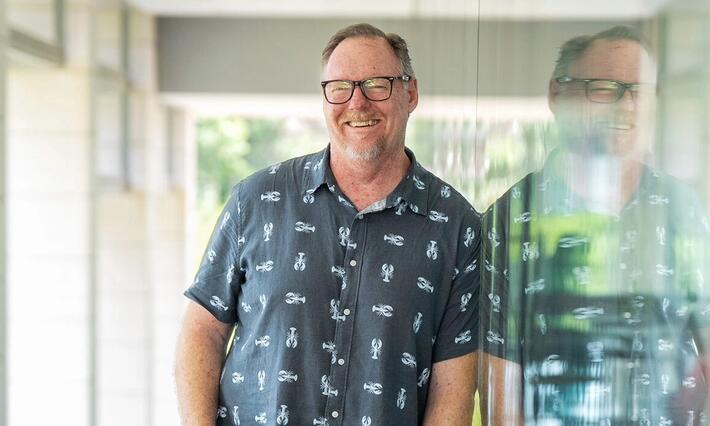
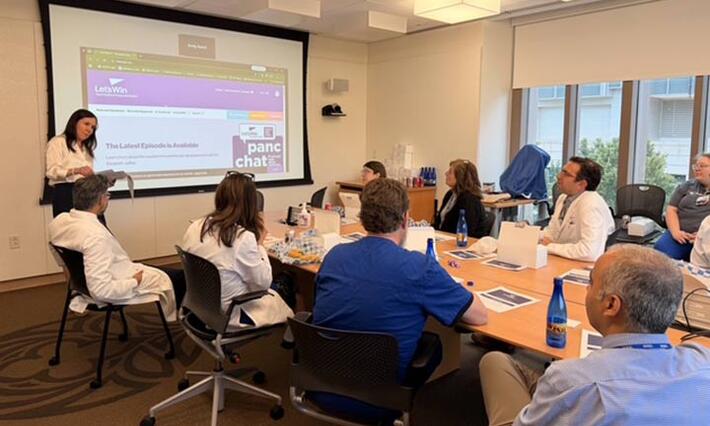
Leighanne Hartman, MSN, RN, AGNP-C, CHPN, CCRC, the clinical research nurse assigned to the MOUNTAINEER trial on day one (2017) made a special trip to see Elle at her infusion appointment on June 10, 2021. It had been over two years since they’d last seen each other and they had a lot to catch up on — new dogs, growing kids, and summer plans. For Hartman, the experience of working on MOUNTAINEER for two years and meeting Elle inspired a career change. In 2019, she went back to school to earn nurse practitioner certification so she could engage with more hands-on patient care.“Upon first meeting Elle, she gave off such a positive attitude, exuding optimism, while calling on her faith to sustain her. I was in awe of Elle’s determination to live her life, resolute in finding a treatment to prolong her life and put her cancer in remission,” said Hartman, who now works on Unit 9300, an inpatient unit for critically ill cancer patients.
Mountaineer: A Homegrown Story of Survival & Promise
Published
From the Duke Cancer Institute archives. Content may be out of date.
Global biotech company Seagen Inc. announced positive topline results last month of a pivotal phase 2 clinical trial (called MOUNTAINEER) of tucatinib in combination with trastuzumab in HER2-positive metastatic colorectal cancer. Both drugs are used in breast cancer, a type of cancer where HER2 amplification is common. HER2 amplification is uncommon, however, in colorectal cancer.
The idea to test these drugs in HER2-positive colorectal cancer patients was initiated by Duke Cancer Institute GI oncologist and co-leader of DCI's Precision Cancer Medicine and Investigational Therapeutics Research Program, John Strickler, MD, who first reached out to Seagen (then Cascadian Therapeutics and the maker of tucatinib) around 2015.
On August 8, 2017, the first patient nationwide to be accrued — Elle Charnisky — began the trial at DCI.
Now a 5-year metastatic colorectal cancer survivor, Charnisky is still going strong and most recently shared her story at the DCI 50th Anniversary celebration held on April 14, 2022.
Strickler will present the full data at the European Society for Medical Oncology (ESMO) World Congress on Gastrointestinal Cancer in Barcelona, Spain — to be held June 29 through July 2, 2022. According to Seagen, "data from this trial will form the basis of a planned supplemental New Drug Application to the FDA under the FDA’s Accelerated Approval Program."
UPDATE (January 19, 2023): FDA Approval
Associate Professor of Medicine and GI oncologist John Strickler, MD, and team's milestone work on the clinical trial "MOUNTAINEER" has led to the first FDA-approved treatment regimen for patients with HER2+ metastatic colorectal cancer. Tucatinib (Tukysa, Seagen Inc.), in combination with trastuzumab for RAS wild-type HER2-positive unresectable or metastatic colorectal cancer that has progressed following fluoropyrimidine-, oxaliplatin-, and irinotecan-based chemotherapy, was granted accelerated approval.
READ MORE about Elle's Journey and the History of Mountaineer
SURVIVOR Colorectal cancer survivor Elle Charnisky, 41, finds respite in the Bernstein Family Garden. The rooftop garden is accessible from the Oncology Treatment Center waiting room (Duke Cancer Center Level 4, June 10, 2021, photo by Julie Poucher Harbin)
In 2017, Elle Charnisky, then a 37-year-old mother of two children under five, had 7 months to live. She was nearly out of options.
Elle Charnisky (in a black & white shirt at center) and her care team celebrate her survival at Duke Cancer Institute's 50th Anniversary commemoration, held on the lawn of Duke Cancer Center on April 14, 2022. (photo by Drawbridge Media)
In Her Own Words, April 2022
"When we sat down in the office of Dr. John Strickler, who is truly one in a million, we had a sense that our lives were never going to be the same... "
A team at the Duke Cancer Institute (DCI) is launching a first-of-its-kind study that could bring new hope to patients living with advanced colorectal cancer.Led by medical student Cheryl Chang and DCI medical oncologist Nicholas DeVito, MD, the project explores why some colorectal cancers that spread to the liver respond well to chemotherapy while others do not. The team recently presented this research at the American Association for Cancer Research (AACR) Immuno-Oncology (IO) Conference.This type of cancer can be especially challenging to treat. Patients often face fewer effective options, and outcomes can vary widely. By taking a closer look at what’s happening inside the tumor before and after treatment, the Duke team hopes to uncover clues that could one day guide more personalized and more effective care.When colorectal cancer spreads to the liver at the time of diagnosis, it often means a tougher road ahead. Doctors know that these patients typically do not respond to chemotherapy the same way others do, but the reasons behind that difference remain unclear.“If we can understand why some patients don’t respond well, we may be able to adjust treatment earlier, or develop new options altogether,” Chang said.To do this, the team is studying tissue samples taken from patients before treatment, when the cancer is first discovered, and after about six months of chemotherapy, when surgeons remove part of the liver or colon.Looking at these pairs of samples gives researchers a rare opportunity to see how cancer and the immune system around it changes during treatment.This is the first known study to compare liver metastasis samples before and after chemotherapy in this specific patient group. Despite decades of using chemotherapy to treat colorectal cancer, surprisingly little is known about how treatment affects the immune environment inside these tumors.“This is an area that’s been largely unexplored,” DeVito said. “We’re excited to contribute something new that has the potential to change how we approach treatment.”A big focus of the study is the tumor microenvironment, the community of immune cells, cancer cells, and other structures within and around each tumor. Using two advanced technologies, the team examines the tumor at both the protein and RNA levels.Working with John Hickey, PhD, assistant professor of biomedical engineering at the Pratt School of Engineering, the team employed the Codex assay in the study. By using special antibodies to highlight different cell types, the assay lets researchers map where various immune cells are and how close they are to the tumor.The team also partnered with Erika Crosby, PhD, assistant professor in the Duke Department of Surgery, to use the Xenium assay, which analyzes the RNA within cells. This helps confirm the protein‑level findings while revealing additional details that might not show up at the protein stage.Early results show meaningful differences between patients who respond to chemotherapy and those who don’t. Some immune cells appear in higher numbers in people who respond well, suggesting these may serve as early indicators of how effective chemotherapy might be.“Without this collaboration between surgery and biomedical engineering, locating and reviewing patient records and samples would have been far more time‑consuming,” DeVito said. “Everything came together at the right time: the technology, the expertise, and access to the right samples. That’s what makes a project like this possible.”A major boost for this work also came from CRUSH Colorectal Cancer, which supports early‑stage ideas that need initial funding before they can compete for larger grants.“CRUSH provided the seed funding that allowed us to get started,” DeVito said. “An added benefit is that any data generated becomes a shared resource for the entire GI oncology team at Duke.”Looking ahead, the team plans to expand their research into mouse models in collaboration with Jatin Roper, MD, that mimic how colorectal cancer spreads to the liver. This could help them test the biomarkers they discover and explore new treatment strategies in the lab.“Ultimately, everything we’re doing comes back to the patient,” Chang said. “We want to find better ways to treat this cancer, especially for patients who don’t have many options today.”The annual CRUSH Colorectal Cancer 5K will be held on March 14. Learn more about the event.